Does it matter how many meals you eat a day
Three meals, five meals or one big one: this looks at what the research says about how many times a day you eat, and whether it changes muscle, fat or performance.
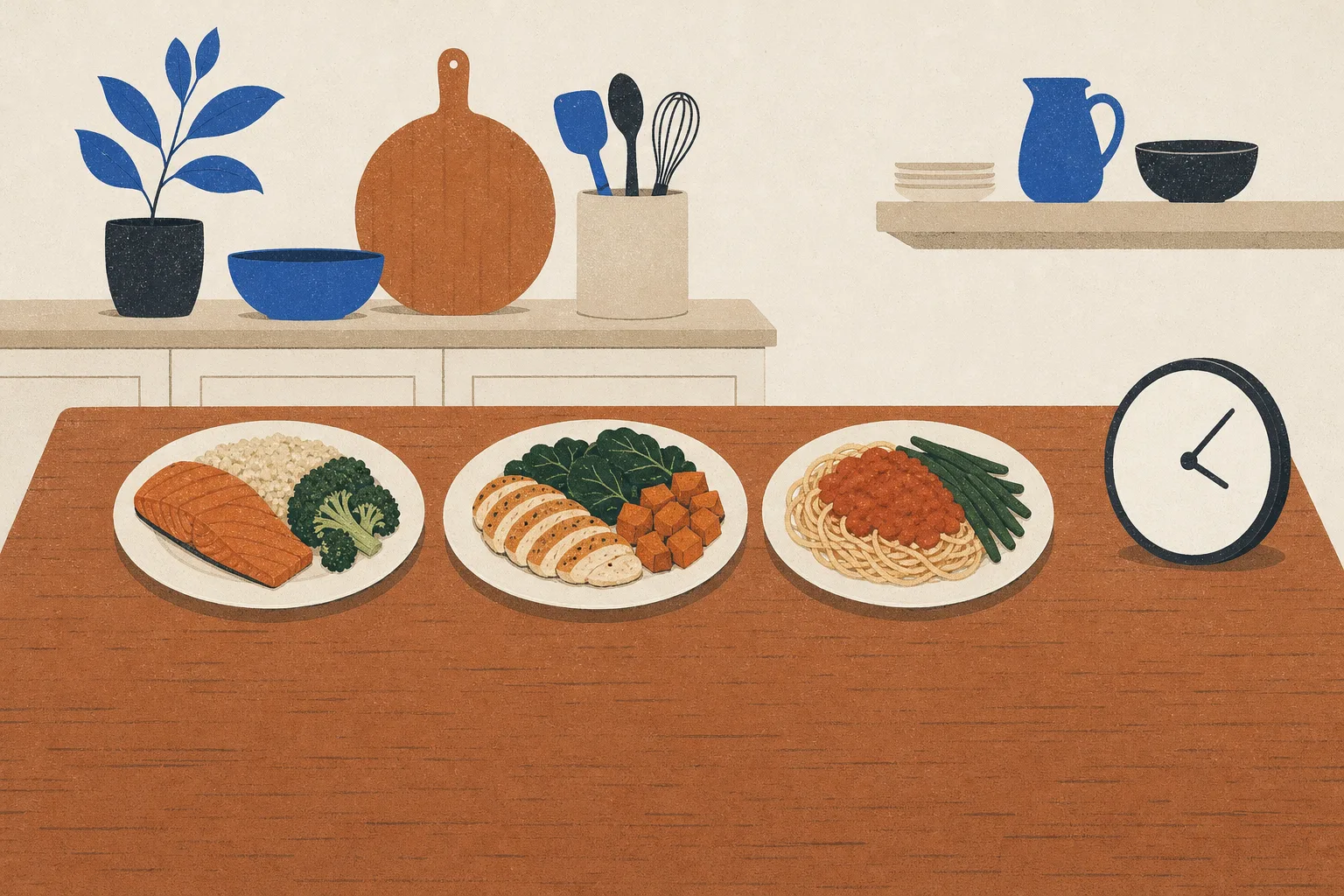
People worry a lot about meal count. Should you eat six small meals to keep your metabolism going? Is one big dinner going to make you store fat? The honest answer is that how many times you eat barely matters next to how much you eat and how much protein you get in across the day.
What changes your weight
Your body weight moves based on the gap between calories in and calories out, not on how that food is split across meals. A meta-analysis of 15 studies spanning meal frequencies from one to nine a day and lasting up to a year found that meal frequency did not change total body weight. Controlled lab studies that measured 24-hour energy burn across very different meal counts have found the same thing: the old idea that more meals speeds up your metabolism has been refuted again and again.
So if you're cutting or bulking, pick a number of meals that fits your day and stick with it. Three meals, two meals, five meals. What moves the scale is the total calories, not the count of plates.
Where meal count can matter a bit
Protein is a different story, but only at the edges. Your body can only use so much protein at once to build muscle. Spreading it out in moderate doses across the day, rather than skewing it all into one meal, seems to help. A controlled feeding study found that consuming a moderate amount of protein at each meal stimulated muscle building over 24 hours more than loading most of it into dinner. Separate work in trained people has linked eating enough protein often enough, with a reasonable dose each time, to better lean mass and muscle performance.
That doesn't mean you need a rigid schedule. It means if you're only managing to eat twice a day and most of your protein ends up in one sitting, splitting it into three or four servings is probably a small, free upgrade. If you already spread your meals out naturally, you're likely fine.
Fasting windows and training
Time-restricted eating, where you fit all your food into a shorter window like eight hours, has become popular. When it's tested against regular eating patterns at the same total calories and protein, with resistance training on both sides, the results are close to a wash. A twelve-week trial comparing intermittent fasting with steady daily calorie cutting in people doing resistance training found similar changes in body composition and strength between the two approaches. An eight-week study of time-restricted eating in trained men also reported it didn't harm strength when calories and protein were held steady.
Total calories and total protein do the heavy lifting. Meal count is mostly a scheduling choice.
There's a practical catch with short eating windows though: cramming all your food and protein into a few hours can be genuinely hard to do, especially on a higher-calorie bulk. If a fasting window is making it a struggle to hit your targets, that's a real cost even if the muscle research looks neutral on paper.
So what should you actually do
Pick a meal count that fits your life Two, three, four or five meals all work fine for weight and muscle, as long as the totals are right.
Spread protein across the day Aim for a reasonable serving at most meals rather than one huge dose at dinner.
Be honest about fasting windows If a short eating window makes it hard to eat enough, especially protein, widen it.
Stay consistent Whatever pattern you choose, the main thing is sticking to it so your calories stay predictable.
If eating patterns feel more complicated than this, if you're skipping meals out of anxiety rather than choice, or meal timing is tangled up with how you feel about food, that's worth talking through with a doctor or dietitian rather than solving with a different schedule.
Sources
- International society of sports nutrition position stand: nutrient timing Journal of the International Society of Sports Nutrition
- Full article: International Society of Sports Nutrition position stand: diets for body weight reduction Journal of the International Society of Sports Nutrition
- Dietary Protein Distribution Positively Influences 24-h Muscle Protein Synthesis in Healthy Adults Journal of Nutrition
- Per meal dose and frequency of protein consumption is associated with lean mass and muscle performance Clinical Nutrition
- Intermittent fasting and continuous energy restriction result in similar changes in body composition and muscle strength when combined with a 12 week resistance training program