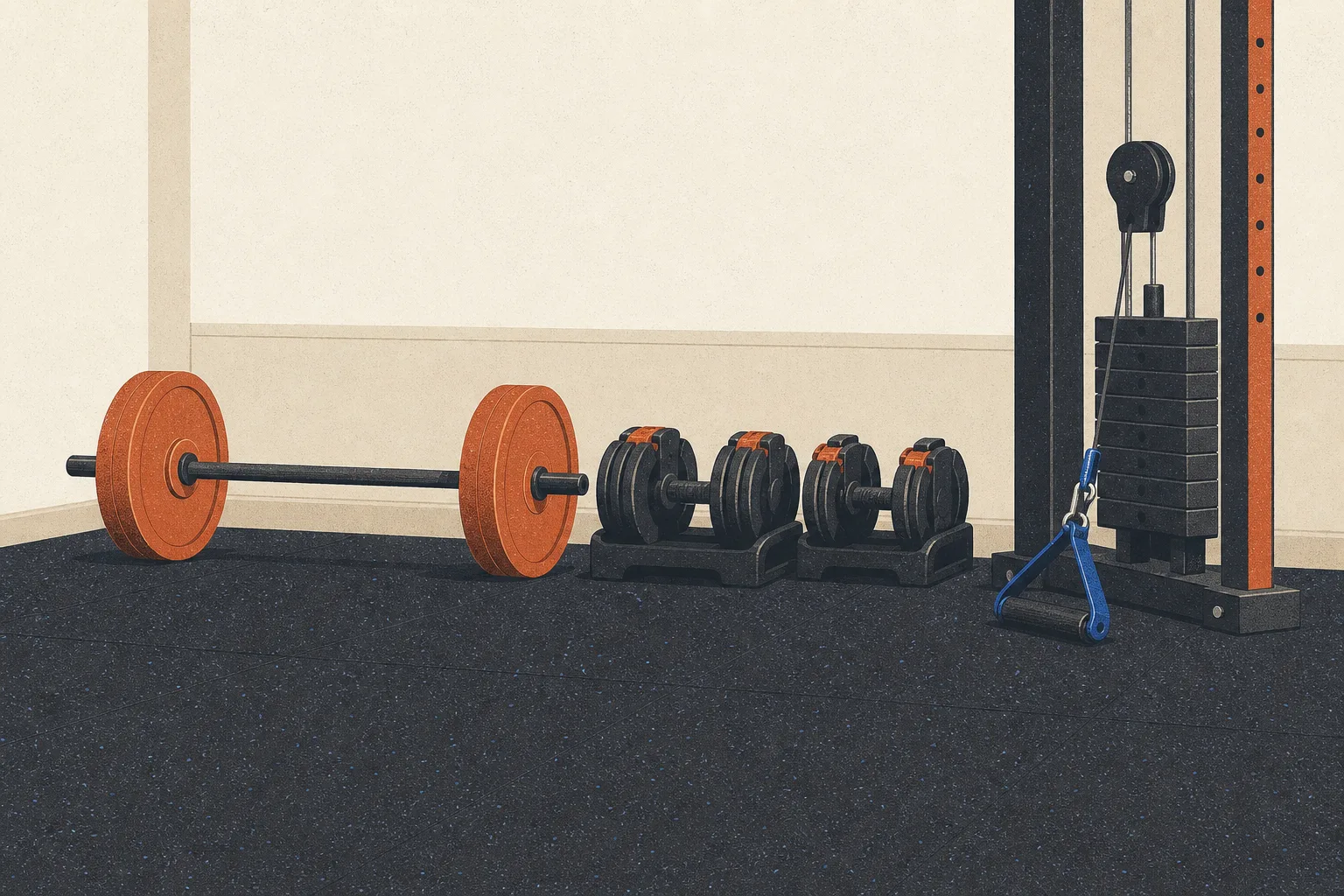
How to choose exercises for a muscle
With so many exercises to choose from, here's what actually changes your results: joint type, range of motion, and free weight versus machine.
Pick up any list of exercises for a muscle and you'll find dozens of options. A chest day could mean barbell bench, dumbbell bench, machine press or cable flyes, and every forum has an opinion on which one is "best". The honest answer is that most well-performed exercises work. What matters more is a short list of simple choices: joint or muscle, range of motion, and free weight or machine.
Multi-joint lifts first, single-joint lifts to finish
A squat or a bench press moves more than one joint at once and works several muscles together. A leg extension or a triceps pushdown moves one joint and isolates a single muscle. A study on resistance exercise selection in trained women compared training with only multi-joint moves, only single-joint moves, or a mix of both. All three groups built muscle everywhere they trained, but the groups doing multi-joint work made <cite index="0-11,0-12">greater increases in gluteus maximus, quadriceps femoris and pectoralis major in comparison with the single-joint group</cite>. Single-joint work wasn't useless, though. For one movement, knee flexion, the single-joint group actually came out ahead, and <cite index="0-9">increases in strength for single-joint exercises were similar among groups, with the exception of leg curl, where the single-joint group obtained greater gains</cite>. A sensible program leans on big, multi-joint lifts for most of its sets, then adds single-joint moves where a muscle needs direct work a compound lift doesn't give it, like hamstrings, rear delts or calves.
Use the range of motion you can control
How far you move the weight matters more than which exercise you pick. A review of training through a full range of motion versus a shortened one found that full range training built more muscle in the lower body than partial reps did. But the story isn't all one way. Newer work on partial reps taken specifically at the lengthened, stretched end of a movement has found they can build muscle about as well as full reps in people who already train, and in at least one study the partial group added more total work along the way, which may explain part of the result. The practical takeaway: train through as much range as you can control with good form, and treat a deliberately shortened range as a specific tool rather than a shortcut.
Free weights, machines, or both
Free weights ask your body to balance and stabilise the load as well as move it. Machines fix the path for you. A review comparing the two for size, strength and power found each was better at improving performance on its own type of test. Strength gains were larger on free weights when tested with free weights, while machine training tended to transfer better to machine tests. For muscle growth itself, the two approaches came out close to even. That matches what most coaches already do: use free weights for the main lifts because the skill carries over to daily life and sport, and use machines to safely push a muscle hard, especially late in a workout when technique can slip under fatigue.
Start with one or two big lifts Pick a multi-joint movement for each major muscle group, like a squat, row, press or hinge.
Add single-joint work for gaps Use isolation exercises for muscles the big lifts don't fully cover, such as hamstrings, calves or rear delts.
Move through a range you can control Full range of motion is the safer default; use shortened ranges only as an occasional, specific tool.
Mix free weights and machines Lean on free weights for your main lifts and machines for isolation work or when fatigue makes form harder to hold.
Keep exercises stable for a while Give an exercise several weeks before swapping it, so you can actually track whether the weight or reps are going up.
Most well-performed exercises work. The real choices are joint type, range of motion, and free weight versus machine.
None of this means you need a huge list of exercises to make progress. A small set of lifts, picked for a reason and given time to progress, beats a program that changes every week just to feel fresh. If you're working around an old injury or ongoing pain, it's worth checking with a physiotherapist or qualified trainer about which exercises and ranges of motion suit your body before you build a routine around them.
Sources
- The Effects of Resistance Exercise Selection on Muscle Size and Strength in Trained Women PubMed
- Effects of range of motion on resistance training adaptations: A systematic review and meta-analysis Scandinavian Journal of Medicine & Science in Sports
- Lengthened partial repetitions elicit similar muscular adaptations as full range of motion repetitions during resistance training in trained individuals PMC
- Effect of free-weight vs. machine-based strength training on maximal strength, hypertrophy and jump performance – a systematic review and meta-analysis BMC Sports Science, Medicine and Rehabilitation