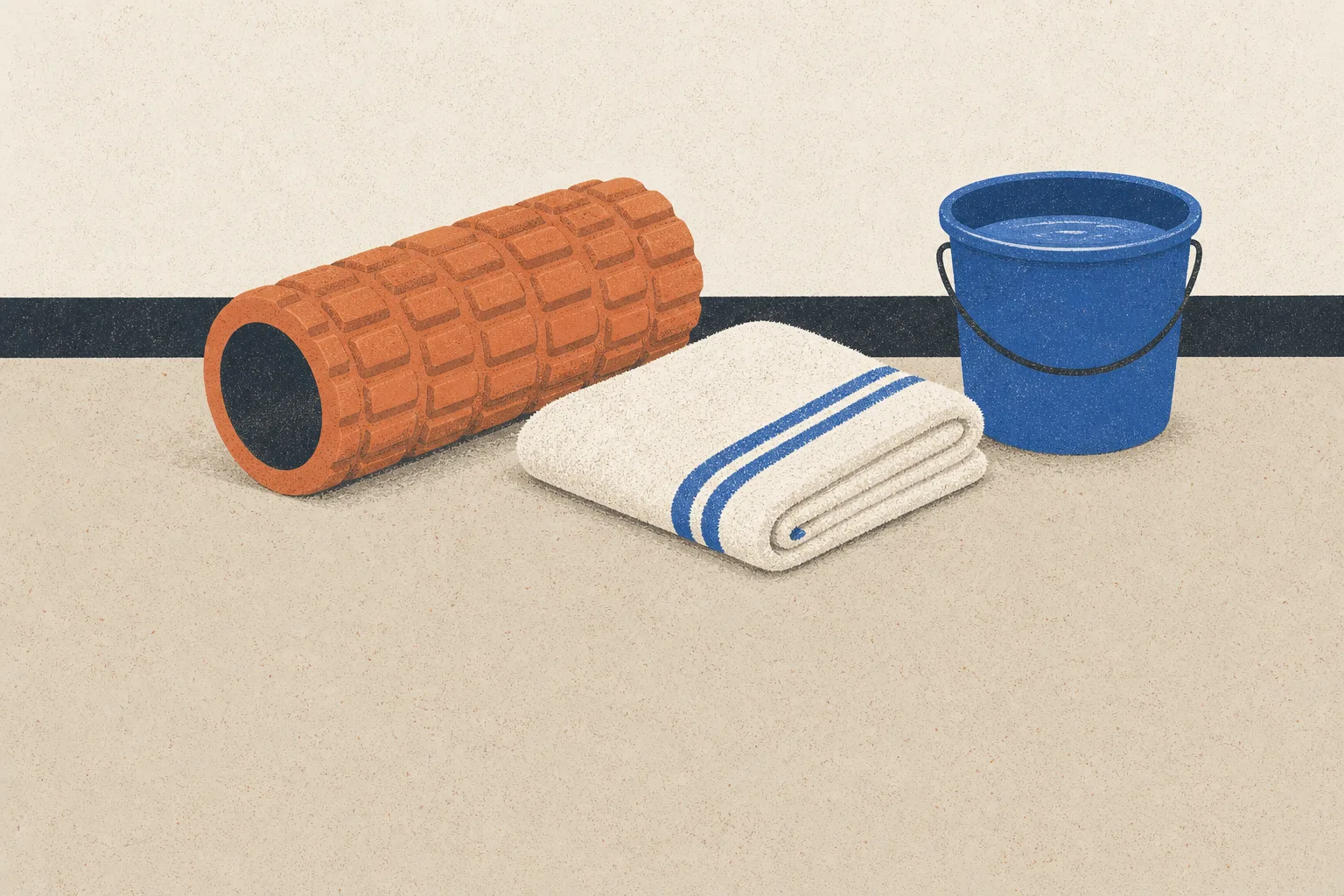
Foam rolling, massage and ice baths: what the research says
Foam rollers, massage and ice baths all promise faster recovery, but the research says they don't all do the same job, and one may work against your gains.
Foam rollers, massage guns, ice baths. Walk into most gyms and you'll see someone rolling a calf or climbing into a cold tub right after their last set. These tools feel good, and some of them really do take the edge off sore muscles. But "feels better" and "recovers better" are not the same thing, and for one of these tools the science points the other way.
What actually eases soreness
Foam rolling has decent support behind it. A review of the research found that foam rolling resulted in increased pressure-pain threshold score, sprint speed, power, and dynamic strength-endurance at various points after hard exercise. That means less tenderness and a bit less drop-off in how your muscles perform, not a cure, just a small help.
Massage shows something similar. A systematic review and analysis of many trials found that muscle soreness rating decreased significantly when participants received massage compared with no intervention at 24, 48 and 72 hours after exercise. So both foam rolling and massage seem to take some of the sting out of sore muscles in the day or two after a hard session.
Where ice baths cause a problem
Cold water immersion is a different story if you're lifting weights to get stronger or build muscle. One trial on resistance training found that post-exercise cold water immersion attenuates muscle fiber growth with resistance training, potentially mediated by attenuated post-exercise increases in markers of muscle. In plain terms, jumping in cold water right after lifting seems to blunt some of the signals your muscles use to grow back bigger.
A separate study went further, following lifters over twelve weeks. The researchers reported that cold water immersion attenuates acute anabolic signalling and long-term adaptations in muscle to strength training, and even wrote that people using strength training to build muscle should therefore reconsider whether to use cold water immersion as a routine recovery tool. A larger pooled analysis of the evidence came to a similar place, finding some evidence of greater hypertrophic adaptations with resistance training alone compared with resistance training plus cold water immersion.
An ice bath can dull the soreness, but it may also dull the muscle growth that soreness came from.
After a hard leg day Reach for a foam roller or get a massage if it's available, not an ice bath.
If you compete soon Cold water immersion for quick recovery between events is a different use case than everyday training, so the trade-off matters less.
If soreness is severe Or lasts well beyond a few days, or comes with swelling or sharp pain, see a qualified professional rather than guessing.
So what's actually worth doing
None of these tools replace the basics that drive recovery: enough sleep, enough food and enough time between hard sessions on the same muscle. Foam rolling and massage are reasonable extras if you enjoy them and have the time. They won't make you recover faster in any measurable way, but they can make the sore day or two feel more comfortable. Ice baths are worth a second thought if your main goal is building muscle or getting stronger, since the same cold that calms the soreness also seems to cool off part of the growth signal.
- Foam rolling: modest, short-term easing of soreness and a smaller drop in performance after hard exercise.
- Massage: similar easing of soreness, shown across multiple trials.
- Ice baths: may blunt muscle growth and long-term strength gains when used regularly after lifting.
Sources
- Foam Rolling for Delayed-Onset Muscle Soreness and Recovery of Dynamic Performance Measures PMC
- Massage Alleviates Delayed Onset Muscle Soreness after Strenuous Exercise: A Systematic Review and Meta-Analysis Frontiers in Physiology
- Cold water immersion attenuates anabolic signaling and skeletal muscle fiber hypertrophy, but not strength gain, following whole-body resistance training Journal of Applied Physiology
- Post-exercise cold water immersion attenuates acute anabolic signalling and long-term adaptations in muscle to strength training PMC
- Throwing cold water on muscle growth: A systematic review with meta-analysis of the effects of postexercise cold water immersion on resistance training-induced hypertrophy European Journal of Sport Science